
For: Owners, managers and billing staff · Permission: Manage Billing Hub · Time: ~5 minutes
Quick summary
- Open Billing › Billing Hub and check the aging cards.
- Narrow the list with the filters or the search box.
- Select the service orders you want to bill or collect on. Pick orders from one customer, because a statement or payment covers one company.
- Click Create Statement to ask the customer to pay, or Record Payment when money has arrived.
- Check the Statements and Payments tabs for the record.
Before you start
- You need the Manage Billing Hub permission. If Billing Hub is missing under Billing in the left menu, ask an admin.
- The invoice must already be sent. See Approve and Send an Invoice.
- A statement goes to the company's contacts listed under Customer. A receipt goes to the billing contact. Open the panel and read who it goes to before you send.
Read the Billing Hub
Open Billing › Billing Hub in the left menu. The top of the page shows how many service orders still owe money and their total. Paid orders stay in the list but aren't counted. Four cards split that total by age: Current, 31–60 days, 61–90 days and 90+ days. Each card shows a dollar amount and a count of service orders.
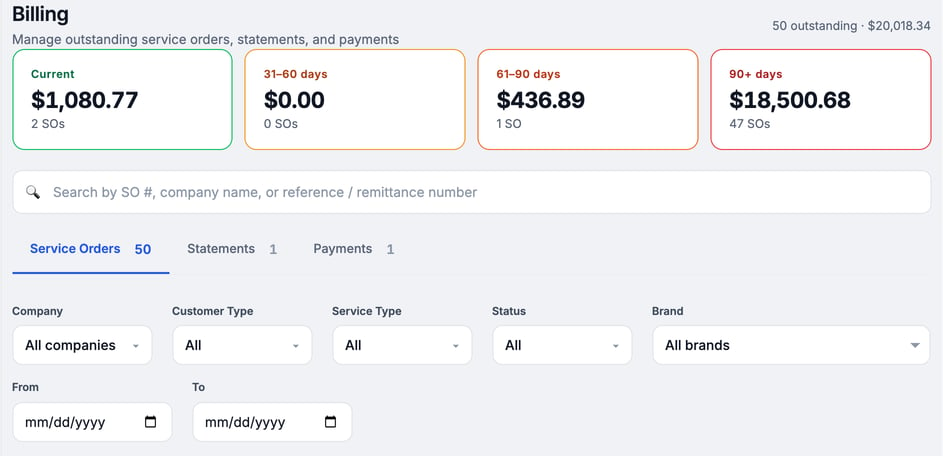
Below the cards you have three tabs: Service Orders, Statements and Payments. Each tab shows a count.
Find the invoices you need
Type in the search box to find an order by service order number, company name, or reference or remittance number. You can also use these filters:
- Company: pick one or more customers.
- Customer Type: Account or COD.
- Service Type: for example Repair or PM.
- Status: Unpaid, Partial, Paid, Written off or Refunded.
- Brand: one of your brands.
- From and To: a date range.
The table lists SO #, Company, Type, Service, Invoice Date, Invoice Amount, Paid, Balance, Status, Age and Invoice PDF. Age counts days since the invoice date, at the shop, and the aging cards count the same days. On PM and Inspection orders, the invoice date is the day the invoice was sent, the same date as on its PDF. The date filter, sort and Create Statement use it too. Click a column heading arrow to sort. The ⋯ at the end of a row holds Credit a line, Write off and Refund. See Record a Payment and Apply Customer Credit. A row shows what is left after refunds, with a line such as "$40.00 refunded" under the status. An order refunded in full shows a grey Refunded status, and its Age reads Refunded with the date. Click Preview in the Invoice PDF column to open a fresh copy of the invoice in a new tab. If it fails, you see "We couldn't open the PDF. Try again."
Select service orders
Select the box at the start of each row. A bar appears above the table with the number of orders selected, the customer, and their combined balance. If you pick orders from several companies, the bar shows a count, such as 2 companies, instead of a name, and Create Statement and Record Payment ask you to unselect or filter by company. Click Clear to start over.
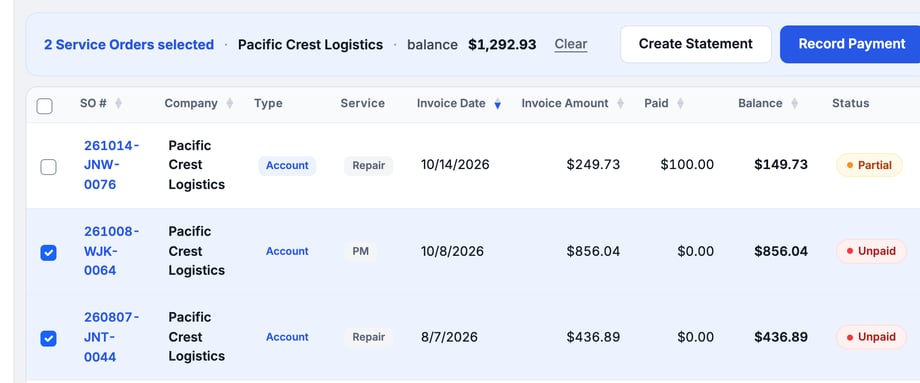
The bar holds the two actions: Create Statement and Record Payment.
Send a statement
- Select the orders. Select every order the statement should cover.
- Click Create Statement. A panel opens on the right with the total balance.
- Leave Manual Collection selected. It is the only channel you can choose. Send Payment Link and Charge Card on File are greyed out. The statement carries no payment link. The customer pays the way they usually do. Record the payment when it arrives.
- Check the recipients. Under Customer, check who gets the email. Use Send to (additional email) to add or override an address. Add a Message to customer if you want a note in the email.
- Review, then send. Click Preview to see the statement. Click Send Statement to send it.
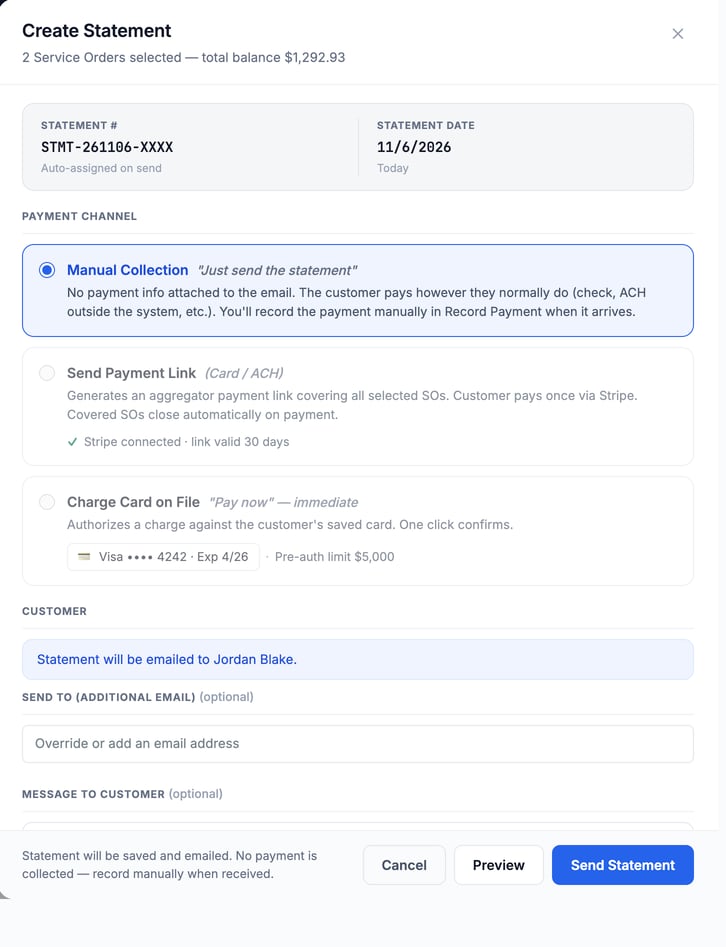
Clicking Send Statement saves and emails the statement at once. No payment is collected. Record it when it arrives.
Record a payment
- Select the orders the payment covers.
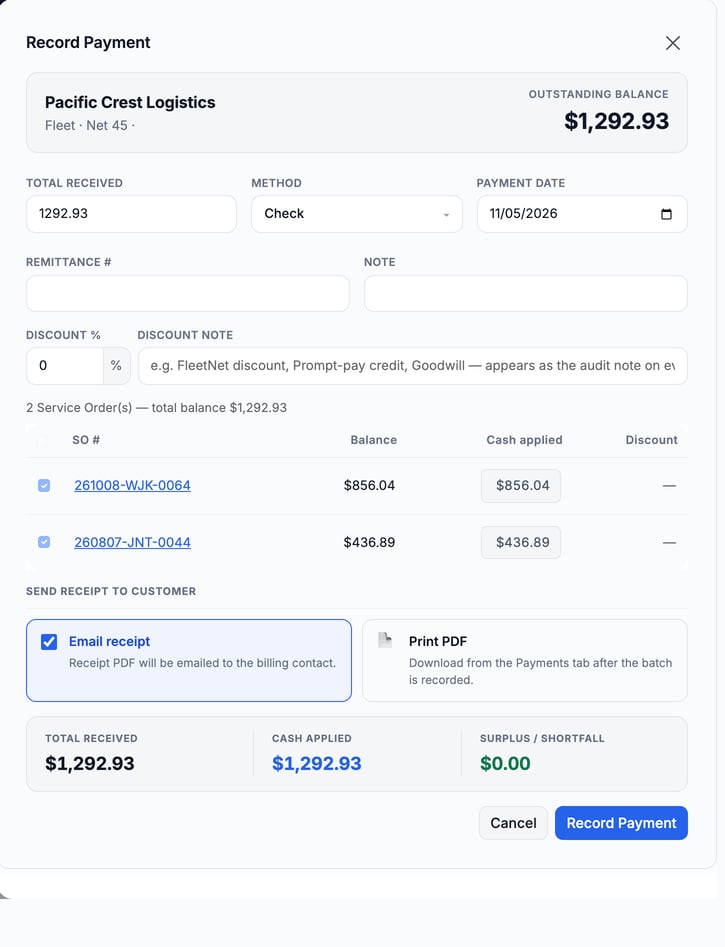
- Click Record Payment. A panel opens with the customer's outstanding balance.
- Fill in the payment. Enter Total received, choose the Method and set the Payment date. The date can't be after today at your shop. If you pick a later day, the panel says "It's still [today's date] at the shop. Pick [today's date] or earlier: the day the money arrived." Add a Remittance # or a Note if you have one. If customer credit covers the whole balance, Total received can stay at $0.00.
- Add a discount if one applies. Enter a Discount % and a Discount note.
- Check the split. The table shows each order's Balance, the Cash applied and any Discount. At the bottom, Surplus / Shortfall should read $0.00. If you received more than the balance, choose whether the surplus becomes customer credit or a refund.
- Watch for an out-of-date warning. If an order's invoice changed after it was sent, a line under its number reads Invoice out of date and says what the customer was billed and what the order totals now. The payment still pays off the invoice you sent. Resend the invoice from the order to bill the difference.
- Choose a receipt. Email receipt sends a PDF to the billing contact. No receipt goes out when Total received is $0.00. Print PDF lets you download it from the Payments tab afterward.
- Click Record Payment.
Check statements and payments
The Statements tab lists each statement with its Number, Date, Company, Status, Total, when it was Sent, and a PDF to preview.
The Payments tab lists each recorded payment with its Payment #, Date (the day you picked as the Payment Date), Company, Source, Method, Reference, Total, who it was Recorded By, and its Status.
Troubleshooting
| Symptom | Likely cause | Fix |
|---|---|---|
| Billing Hub is missing under Billing in the left menu | Your role doesn't include the Manage Billing Hub permission | Ask an admin to give you access. |
| An order you expect isn't in the list | A filter or the search box is narrowing the list | Untick every option so each filter reads All, clear the search box and clear the dates. |
| Record Payment is greyed out | None of the selected orders can take a payment | Click Clear and select orders that still show a balance. Hover the button to see why it is disabled. |
| A message says "A payment for this invoice is already in progress." | A card payment on that order is still being processed, so it can't be part of a batch or credit yet | Wait for the card payment to finish, or clear that order from the selection and try again. If Stripe never answered, the invoice stays locked. After 8 minutes, click Check Stripe on the repair order's Billing tab. See Connect Stripe to Take Card Payments. |
| A message says "Only $X.XX of company credit is left now" | Someone else used the customer's credit first | Nothing was saved. Check the amounts and record the payment again. See Record a Payment and Apply Customer Credit. |
| "Total received must be greater than zero." | Total received is $0.00 and no customer credit is applied | Enter the amount you received, or turn on Apply customer credit. See Record a Payment and Apply Customer Credit. |
| The Surplus / Shortfall isn't $0.00 | The amount received doesn't match the balances | Change Total received, or lower the selection so it matches the money you got. |
| The statement didn't reach the customer | The recipient on the Customer line isn't the right contact | Check the contacts on the company. You can add another address in the panel. |
FAQs
What's the difference between a statement and an invoice?
An invoice covers one service order. A statement bundles the open balance of several orders into one request for payment.
Do I have to send a statement to record a payment?
No. Record Payment works on its own whenever money arrives.
Can I see a paid order?
Yes. Set Status to Paid. The Age column then reads Paid with the payment date. On a repair order, that's the Payment date picked when the payment was recorded.
Where do late fees come from?
See Late Fees and Interest on Overdue Invoices.